If you’re considering epoxy flooring for your garage, workshop or commercial space, durability is probably near the top of your list.
After all, there’s little point spending money on a new floor if it starts scratching, peeling or wearing out after a couple of years.
So, are epoxy floors durable?
Yes. A properly installed epoxy flooring system is highly durable and can handle heavy foot traffic, vehicles, abrasion, oil, many common chemicals and everyday wear. But the final result depends on more than the epoxy itself. Surface preparation, product quality, installation and the conditions the floor is exposed to all make a difference.
That’s why two epoxy floors can look similar when they’re new but perform very differently over time.
How Durable Are Epoxy Floors?
Epoxy is one of the more durable options for garages, workshops and many commercial environments because it forms a hard protective coating over the concrete.
A quality system can withstand regular use such as:
- Cars, SUVs and 4WDs
- Daily foot traffic
- Toolboxes and storage equipment
- Home gym equipment
- General workshop activity
- Oil and grease spills
- Regular cleaning
- Moderate abrasion and impact
For a typical residential garage, this makes epoxy a practical long-term flooring solution rather than simply a decorative coating.
However, durable doesn’t mean indestructible.
Dragging heavy steel equipment across the surface, allowing abrasive grit to build up or dropping extremely heavy objects can still cause damage. Like any flooring material, epoxy has limits.
The important question isn’t whether epoxy can ever be damaged. It’s whether it can reliably withstand the type of use your floor will actually experience.
How Long Does an Epoxy Floor Last?
There’s no single lifespan that applies to every epoxy floor.
A well-installed residential garage floor can potentially last 10 years or more, while commercial and industrial floors may require recoating sooner depending on traffic, machinery, chemicals and impact.
The biggest factors include:
- Quality of the flooring system
- Concrete preparation
- Thickness and number of coats
- Protective top coat
- Level of traffic
- Exposure to chemicals and abrasion
- Ongoing maintenance
A cheap coating applied quickly to poorly prepared concrete shouldn’t be expected to perform like a professionally installed multi-coat system.
In other words, the lifespan isn’t determined by the word “epoxy” on the product label. The complete flooring system matters.
What Makes Epoxy Flooring Durable?
Proper Concrete Preparation
This is one of the most important parts of the entire installation.
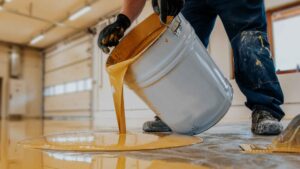
Before epoxy is applied, the concrete needs to be clean, sound and properly prepared. Mechanical grinding is commonly used to remove contaminants and create the surface profile needed for the coating to bond properly.
Oil, grease, old coatings, dust and other contaminants can interfere with adhesion.
If preparation is rushed, the epoxy may look perfectly fine when first installed but later develop peeling, delamination or premature wear.
That’s why professional floor preparation isn’t just an optional extra. It’s part of what makes the finished floor durable.
Quality Epoxy Products
Not every epoxy product is formulated for the same conditions.
Basic DIY kits can be suitable for certain projects, but professional and commercial-grade systems are generally designed to provide higher performance in demanding environments.
When choosing a system, it’s worth considering the actual use of the floor rather than simply choosing the cheapest product available.
A residential garage, automotive workshop and warehouse may all require different levels of performance.
Protective Top Coats
A protective top coat can add another layer of defence against everyday wear.
Depending on the system, polyurethane or polyaspartic coatings may be used over epoxy to improve properties such as:
- Abrasion resistance
- Scratch resistance
- Chemical resistance
- UV resistance
- Overall surface protection
The right top coat depends on the environment and the flooring system being installed.
Can Epoxy Floors Handle Cars and Heavy Traffic?
Yes. Vehicle traffic is one of the reasons epoxy flooring is so popular in garages.
A properly installed system can handle everyday parking from passenger vehicles, SUVs and 4WDs without a problem.
However, garages aren’t only exposed to vehicle weight.
Tyres can bring sand, gravel and other abrasive particles onto the floor. Turning tyres repeatedly in one spot can also create more wear than simply driving onto a parking space.
Another issue worth understanding is hot tyre pickup.
This happens when tyres lift or damage the coating, often because the coating hasn’t cured properly or the flooring system isn’t suitable for the conditions.
It isn’t simply a question of whether epoxy is “strong enough” to hold a car.
Proper product selection, installation and curing all matter.
For workshops and commercial spaces with forklifts, pallet jacks or heavier equipment, the flooring system should be specified according to the expected traffic rather than treating all epoxy as the same.
Are Epoxy Floors Scratch and Impact Resistant?
Epoxy flooring is highly resistant to everyday scratching and wear, but it isn’t scratch proof.
Fine grit and sand can gradually create surface wear, particularly in areas with regular vehicle traffic.
Dragging steel toolboxes, machinery or sharp-edged equipment across the floor can also leave scratches.
Heavy objects dropped from a height may cause impact damage as well.
There are simple ways to reduce this wear. Keep the floor free from abrasive dirt, use rubber pads under equipment and lift heavy objects rather than dragging them.
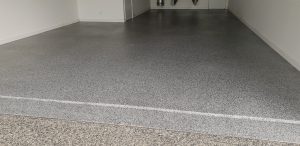
A decorative flake system can also help disguise minor scratches and everyday marks because the variation in colour makes small imperfections less noticeable than they may be on a plain-colour floor.
Are Epoxy Floors Resistant to Oil and Chemicals?
One of epoxy flooring’s major advantages is its resistance to many common garage and workshop contaminants.
A properly selected epoxy system can provide good resistance to substances such as:
- Engine oil
- Grease
- Petrol and diesel
- Cleaning products
- Common workshop chemicals
This makes it particularly useful in garages and automotive environments where spills are difficult to avoid.
However, chemical resistance varies between products. Epoxy shouldn’t be described as completely resistant to every chemical simply because it is epoxy.
If your floor will regularly come into contact with aggressive chemicals, the flooring system should be selected specifically for those substances.
Is Epoxy Flooring Durable Outdoors?
This is where some caution is needed.
Standard epoxy isn’t automatically the best choice for every outdoor application because prolonged UV exposure can cause some epoxy coatings to yellow or lose their appearance.
Outdoor areas also experience rain, temperature changes and greater exposure to the elements.
If you’re considering a coating for a driveway, patio or other exposed concrete area, the system needs to be appropriate for exterior conditions. A suitable UV-resistant protective coating or an alternative flooring system may be more appropriate depending on the application.
So while epoxy can be extremely durable indoors, you shouldn’t assume the exact same system is ideal outdoors.
What Can Cause an Epoxy Floor to Fail?
When you apply epoxy flooring on concrete and it may fail prematurely, the problem isn’t always the material itself.
Common causes include:
- Poor concrete preparation
- Oil or grease contamination
- Moisture beneath the slab
- Incorrect product mixing
- Applying the coating to unsuitable concrete
- Rushing the curing process
- Using an unsuitable system for the environment
- Excessive impact or abrasion
This is why installation quality matters so much.
A durable product cannot compensate for poor preparation.
If moisture is trapped beneath the coating, for example, the resulting pressure can contribute to bubbling, lifting or delamination. If oil remains on the concrete, adhesion can be compromised.
Getting the preparation right from the beginning is usually far cheaper than dealing with a failed coating later.
How Can You Make an Epoxy Floor Last Longer?
Once your epoxy floor is installed, basic maintenance can help preserve its appearance and performance.
Sweep or vacuum regularly to remove sand and grit before it becomes an abrasive layer beneath tyres or equipment.
Clean oil and chemical spills reasonably quickly rather than allowing them to sit on the surface for extended periods.
Avoid dragging heavy metal equipment across the floor. Rubber pads beneath machinery, shelving and workbenches can also reduce unnecessary wear.
It’s equally important to follow the cleaning and maintenance recommendations provided for your specific flooring system.
A little routine care can go a long way when you’re trying to get many years of use from a floor you’ve invested in.
Is Epoxy Flooring Worth It?
If durability is one of your main priorities, epoxy flooring is certainly worth considering.
Its combination of wear resistance, chemical resistance, easy maintenance and appearance makes it particularly well suited to garages, workshops, commercial spaces and many industrial applications.
But don’t judge an epoxy floor solely by the price of the coating.
A cheaper installation may save money initially but can become expensive if poor preparation leads to peeling or premature failure.
A properly specified system, professional concrete preparation and appropriate protective top coat can provide much better long-term value.
The goal isn’t simply to install the hardest possible coating. It’s to choose a flooring system that matches the way the space will actually be used.
Final Verdict
Are epoxy floors durable? Yes, when they’re properly specified, prepared and installed.
A quality epoxy flooring system can handle years of vehicle traffic, foot traffic, abrasion, oil spills and general wear. It’s particularly effective in garages, workshops and commercial environments where ordinary painted concrete may struggle.
But epoxy isn’t indestructible.
Its long-term performance depends on the complete system: the product, concrete preparation, installation, environment and maintenance.
If you’re investing in a new floor, focusing on those factors rather than simply looking for the cheapest epoxy option is far more likely to give you a floor that continues performing well years down the track.
“`htmlFrequently Asked Questions
Find answers to common questions about epoxy garage floor lifespan, durability, preparation and the reasons epoxy floors can fail.